



Rules Topic – Environmentally Sensitive Areas (ESA) — No Play Zones
Rules Topic
Environmentally Sensitive Areas (ESA) — No Play Zones
At a Glance
Defined as
Red Penalty Area
Markers on course
Red stake, green top — or posted ESA sign
Relief type
Mandatory — no option to play
Penalty
1 stroke — Rule 17.1
Can you enter?
No — entry is prohibited
Lost ball rule?
Rule 18.2 does NOT apply — treat as penalty area
PBCGA Hard Card: Ball known or virtually certain to be in an ESA? Take relief under Rule 17.1 with 1 stroke. You may not enter or play from an area marked by red stakes with green caps.
Identify the marker
Red stake with green top, or the green-and-white “Entering Prohibited” sign — either confirms you are at an ESA boundary.
Do not enter the area
You cannot walk in to confirm the ball’s location or assess your lie. If it is known or virtually certain the ball is inside, proceed directly to relief.
Find the reference point
Identify where the ball last crossed the outermost edge of the ESA — this is your reference point for back-on-line or lateral relief.
Choose your relief option (1 stroke)
Stroke-and-distance · Back-on-the-line · Lateral relief (2 club-lengths). All carry a 1-stroke penalty. Full detail in Section 3 below.
⚠ Entering the ESA or playing from within it = general penalty — 2 strokes in stroke play, loss of hole in match play.
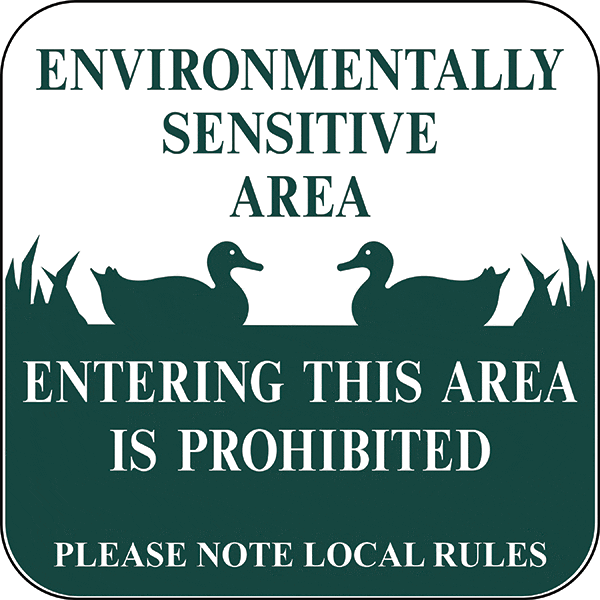
Often, during competition rounds, situations arise that require applying multiple definitions, Local Rules, and the PBCGA Hard Card simultaneously. One scenario that causes consistent confusion — particularly on South Florida courses surrounded by native preserve corridors, wetland buffers, and protected wildlife habitat — involves balls that come to rest in an Environmentally Sensitive Area (ESA) designated as a No Play Zone. You have likely seen the sign posted near these areas: “Entering This Area Is Prohibited — Please Note Local Rules.” That sign carries real stroke consequences.
ENVIRONMENTALLY
SENSITIVE AREA
🖦🖦
ENTERING
PROHIBITED
Environmentally Sensitive Areas are portions of the golf course where play is prohibited to protect the surrounding environment — native vegetation, wildlife habitat, and ecological preserves. These areas carry a harder restriction than most abnormal course conditions.
For most abnormal course conditions — cart paths, ground under repair, immovable obstructions — a player has the option to take free relief. With a No Play Zone, that discretion does not exist. A player is never permitted to play the ball as it lies from within an ESA, nor may a player enter the area. Relief is mandatory.
Under the PBCGA Hard Card, Environmentally Sensitive Areas are defined as red penalty areas. They are identified by two marker types:
Red Stakes with Green Tops
Staked along the ESA boundary — same as a standard red penalty area, but distinguished by the green cap.
Posted Signage
Green-and-white “Entering This Area Is Prohibited” signs adjacent to protected zones on Palm Beach County courses.
Two consequences flow directly from this language. First, a ball lost in an ESA is treated as lost in a penalty area — not as a lost ball under Rule 18.2. If it is known or virtually certain the ball is in the ESA, penalty area relief under Rule 17.1 applies immediately. Second, the player cannot physically enter the ESA to confirm the ball’s location or attempt to play a shot. The prohibition is absolute.
Because the ESA is a red penalty area, the player takes relief under Rule 17.1d with a one-stroke penalty. Three options are available:
As with bridges, bulkheads, and all penalty area situations, the location of your ball determines which relief framework applies.
Ball IN the ESA
Take relief under Rule 17.1 with a one-stroke penalty using one of the three options above. No free relief. Player may not enter the area.
Ball OUTSIDE the ESA
If the ESA interferes with stance or area of intended swing, mandatory free relief applies. Find the nearest point of complete relief and drop within one club-length. Confirm with the PBCGA Local Rules sheet for the specific event.
⚠ Tournament Note — General Penalty Applies
Entering an ESA or playing from within one carries the general penalty: two strokes in stroke play, loss of hole in match play. When stakes are unclear or ball location is uncertain, consult a fellow competitor before proceeding and reference the Local Rules sheet at the starter’s area.